Making visible. Values of ordinary things
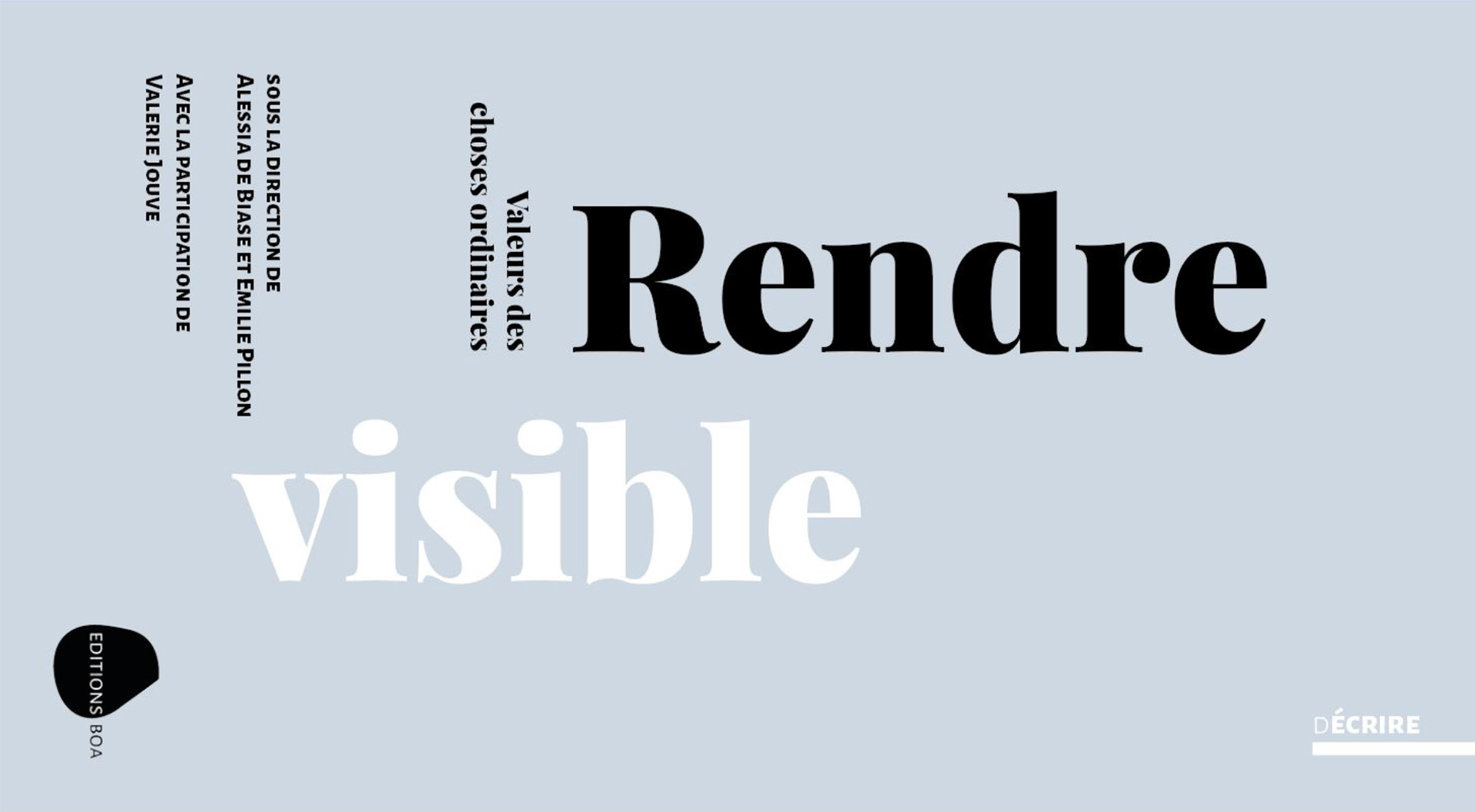
Book cover – © Éditions Boa
Just published in Éditions Boa’s DÉCRIRE collection, this collective work is edited byAlessia de Biase, architect-urban planner, HDR professor in SHS at ENSA Paris-la Villette and director of the LAA-LAVUE research unit, and Emilie Pillon, architect, doctoral student in anthropology at LAA-LAVUE.
As with the other volumes in the collection, one or other artist is involved in a dialogue with the theme of the book: photographer and video artist Valérie Jouve contributed to this work, alongside Catherine Deschamps & Pascale Absi, Philippe Bonnin, Chloé Gaspari, Federica Gatta, Flavia Pertuso & Étienne Kretzschmar, Nadja Monnet & the Momkin association, Mina Saidi Shahrouz, Maud Santini, Anne-Claire Vallet and Valeria Volpe.
Where does the value that holds us together lie? What if it lies in the “almost-nothing” that discreetly weaves the fabric of our shared lives? This book invites us to see it where we no longer look for it. Through fieldwork, the authors explore a powerful equivalence: to make visible is to give value – and what value(s)? It’s a question of shifting our gaze to what really counts: those fleeting gestures, those exchanged words, those everyday rituals, those humble objects that, quietly, connect beings and hold worlds together. From Palestine to urban squats, from Antarctica to solidarity canteens, twelve ethnographic surveys and one photographic study teach us to pay attention. To see how, in the ordinary, hospitality, resistance, care and revolt are created. How a coffee break can become an institution, a set of keys the embodiment of a community, a word opens doors, a swing reveals the fragile geography of childhood.
Far from a simple celebration of the small, this book questions the political significance of these glimpses: what does it mean for the researcher to choose to make these neglected details visible? How does this gesture engage an ethic, a way of being in the world and telling the story of what matters? Using the tools of anthropology and art, this book takes us on a sensitive stroll through weak links and discreet shifts. It invites us to slow down, to observe the tiny textures that bind us together, and to recognize in these “trifles” the mysterious glue – the glutinum mundi – that makes the common persist.