Fred Zelt: "Geology of organic design: Landscapes and building stones of Frank Lloyd Wright sites".
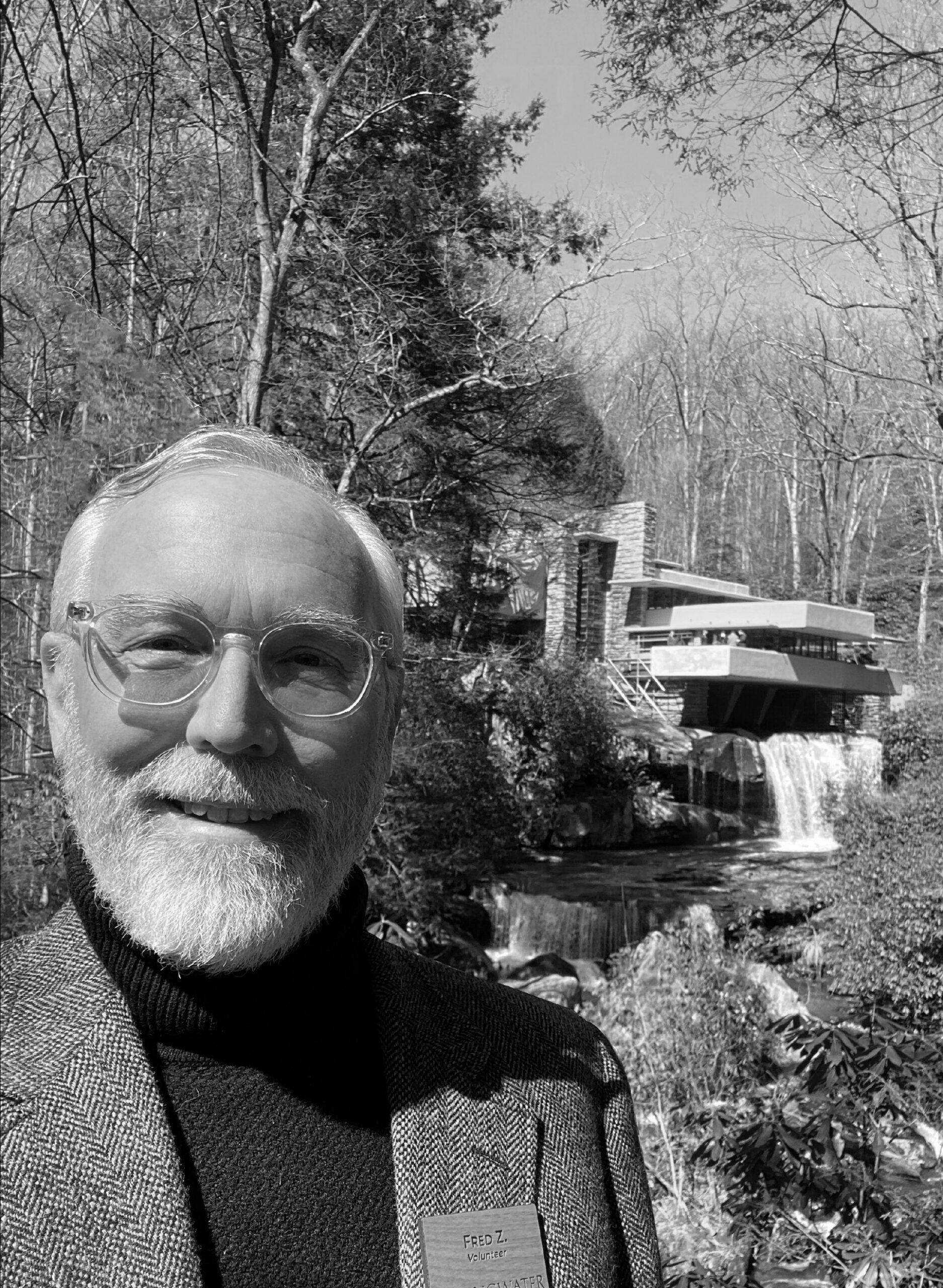
© DR
Following the colloquium ” The legacy of Frank Lloyd Wright in France “, in March 2026, and as part of the research seminar “Ahttep s’expose, Ahttep invite”, the research team welcomes American geologist Fred Zelt for a lecture on the geological dimensions of Wright’s organic architecture.
The lecture is in English.
Buildings with significant stone elements played an essential role in the development of Frank Lloyd Wright’s organic architecture. Of his eight UNESCO World Heritage buildings, three are in stone: Taliesin, Taliesin West and Fallingwater. A naturally imperfect material, stone lends itself ideally to this organic aesthetic. Its geological characteristics make each block unique, allowing it to evolve visibly as it is exposed to the natural elements.
In this lecture, Fred Zelt explores the “geological histories” of Wright’s projects at Hillside, Taliesin and the First Unitarian Society Meeting House (Wisconsin), Graycliff (New York), Fallingwater and Kentuck Knob (Pennsylvania), and Taliesin West (Arizona). He then compares the effects of fire on the Cambrian dolomite of Taliesin and the Lutetian limestone of Notre-Dame Cathedral in Paris. Finally, he discusses the stone buildings of contractor Walter Hall, who led the construction of Fallingwater, and his son, architect Raymond V. Hall. Among their achievements is a building with “Usonian” elements, built the same year as Wright’s first Usonian house (Herbert Jacobs House, 1937).
Biographical details
Fred Zelt is a native of Pittsburgh. He holds degrees in Earth Sciences from the Massachusetts Institute of Technology (B.S.) and Princeton University (M.A., Ph.D.). He worked for thirty years as a geologist and executive with ExxonMobil. In recent years, he conducted the first comprehensive geological studies of stone buildings designed by Wright and Raymond V. Hall. He has lectured and led geological walks in Fallingwater, Graycliff, Taliesin and Taliesin West. He has also produced a series of lectures on YouTube, as well as several scientific publications on these subjects.