LAA / Doctoral thesis defense: Gilles Malzac
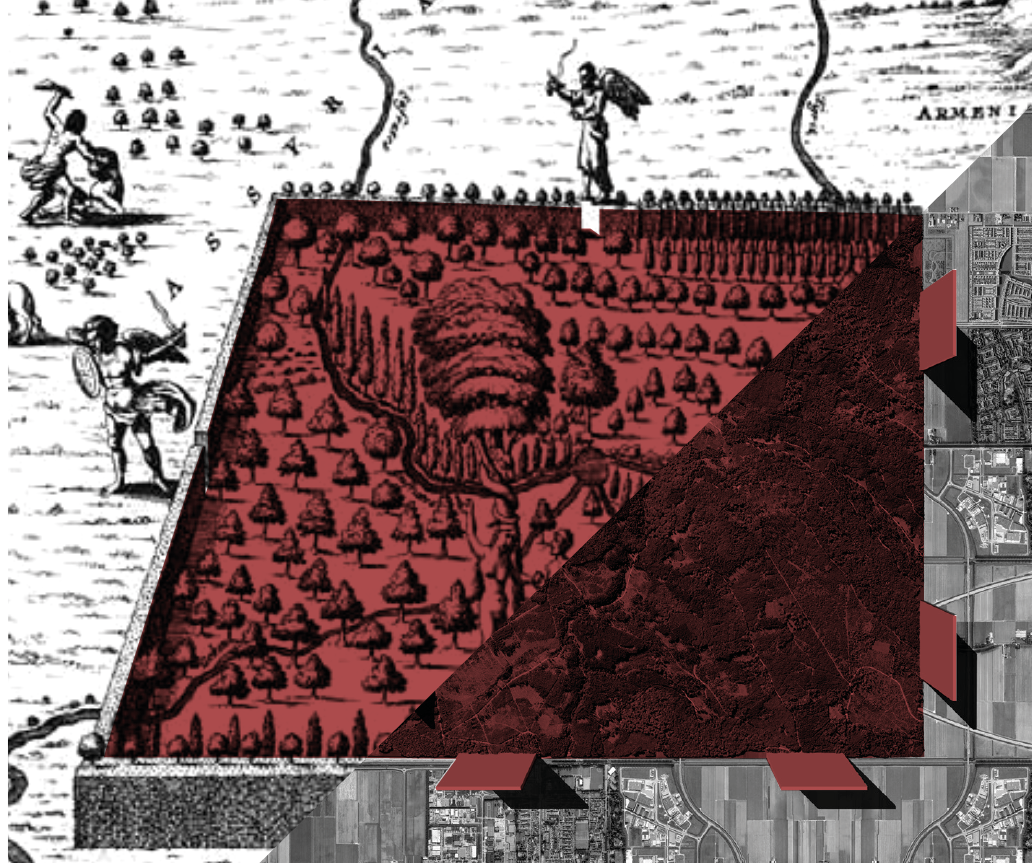
Collage based on two fragments: “Topographie du Paradis terrestre” by Athanasius Kircher (1675)
and “Stop-City” by Dogma (2007)
– © Gilles Malzac
Gilles Malzac, a doctoral student in architecture in the ACS research unit at ENSA Paris-Malaquais – PSL, will present his thesis entitled ” Architecture, criticism & ideological compensation. 1968 – 2008: Manfredo Tafuri, Fredric Jameson, Pier Vittorio Aureli “.
The thesis was prepared under the supervision of Manola Antonioli (ENSA Paris-la Villette) and Jac Fol (ENSA Paris-Malaquais).
Summary
The critique of architectural ideology, as developed by Manfredo Tafuri, historically aimed to reveal the coded message of architectural forms, where the sublimation of capitalism’s contradictions was most intense. It is now up to us to redefine its epistemological and strategic content, as well as its function and role for architecture, in correlation with the capitalogenic assemblages of global warming. Does this critique still allow us to demolish the myth of the durability and transhistorical validity of the values of architecture as an institution? To demonstrate the still-active functionality of architecture’s ideological compensation for capitalist development? Or has it definitively settled into the boudoir of hermeticism and the institutionalization of critique and theory?
In this work, we (re)initiate a dialogue between three male figures: Manfredo Tafuri (1935-1994), Fredric Jameson (1934-2024) and Pier Vittorio Aureli (1973 -). All three, despite their specific historical conjunctures – from Fordist capitalism to neoliberalism – different academic terrains – continental and Anglo-Saxon – and distinct architectural and political modes of intervention, invest the material critique of ideologies to interrogate the place of architecture in capitalist relations of production. In methodological terms, rather than constructing a linear path between these thoughts, we propose to interweave them in order to examine the impasses and contradictions of the concepts produced, as well as their relevance to contemporary issues. The historicization of the thoughts analyzed, imbued with their respective extra-disciplinary contexts – operaism, cultural materialism – also enables us to take a broader critical look at the trajectory of theory in architecture: the shift from a critical investigation of the architectural object, and its conditions of material and ideological production, towards an operational and self-validating architectural theory.
The proposed path, in the vicinity of the analysis of certain fundamental concepts of critical philosophy (ideology, base/superstructure, autonomy), reveals a dialectical tension. On the one hand, architecture, as an institution, does indeed realize, through its forms, techniques and social division of labor, the social relations of domination. On the other, certain types of connection and social practice make it possible to subvert the status quo.
Jury composition
Sébastion Marot, Professor, ENSA Paris-Est (Chairman)
Beatrice Lampariello, Professor, Université Catholique de Louvain (reporter)
Manuel Bello Marcano, HDR lecturer, ENSA Saint-Étienne (rapporteur)
Carmen Popescu, Professor, ENSA Paris-Val de Seine (reviewer)
Alice Sotgia, Senior Lecturer HDR, ENSA Paris-Malaquais (examiner)
Xavier Wrona, Senior Lecturer, ENSA Saint-Étienne (examiner)
Manola Antonioli, Professor, ENSA Paris-la Villette (co-director)
Jac Fol, Professor Emeritus, ENSA Paris-Malaquais (co-director)
Remote access
The defense is public, open to all, and will be broadcast live via the following link for those unable to attend:
Teams link to follow the presentation live
Face-to-face access
To facilitate organization, please register your attendance using the form below:
Sign up