LAA-LAVUE / PhD thesis defense: Enoal Vancoillié
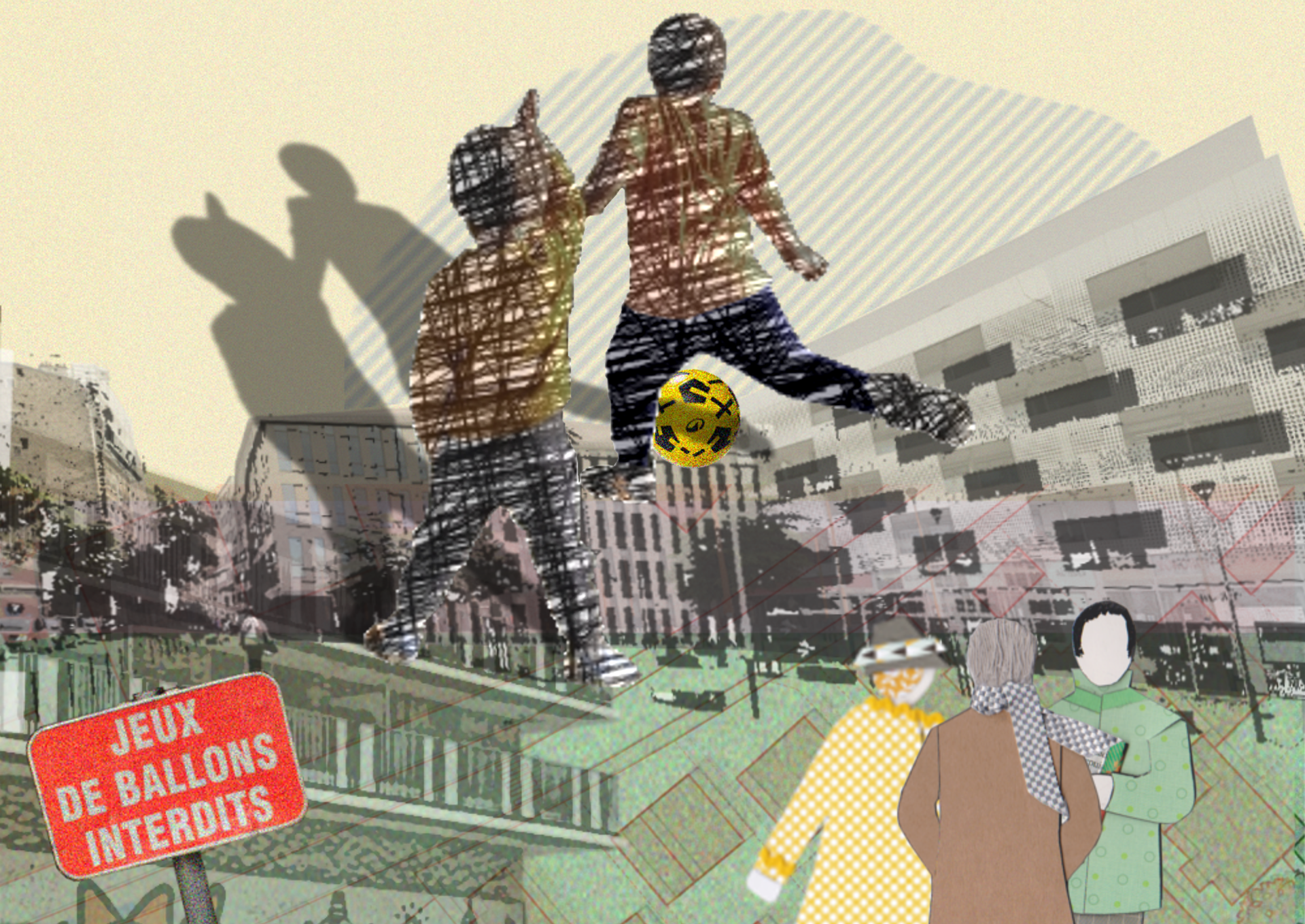
Photomontage – © I. & E. Vancoillié
Enoal Vancoillié will present his doctoral thesis in urban planning and development, entitled “A new approach to urban planning and development”. The city as a playground for ball games. A sensitive exploration of the role of design in urban interaction “under the supervision ofAlessia De Biase (LAA-LAVUE) and co-supervised by Pedro José Garcia Sanchez (Université de Nanterre).
Summary
Is there a place for ball games in town? From the number of prohibition signs popping up everywhere, it’s clear that they’re not always welcome. Our survey focuses on the relationship between football-inspired ball games and their socio-spatial environment. The study of these practices offers an opportunity to uncover the material dimension of urban interactions.
The ball rolls, flies, bounces, bangs, escapes… To play with a ball is to experience a unique encounter with the city. It means being attentive to its materials and the variations in its relief. It means learning to detect opportunities for play and to recognize obstacles likely to “perch” the ball. It also means confronting interactional challenges that vary from place to place and from encounter to encounter. In short, ball games are a way of undertaking and understanding in a different way the sensitive and uncertain nature of life in the city.
Our exploration focuses on various practice areas, both dedicated and non-dedicated to ball games in the city.
The citystade is a dedicated space that contains the ball’s movements and ensures the safety of users in the immediate vicinity. This facility has established itself as a benchmark for ball games in the urban environment. It is as attractive to players looking for a place to legitimize and let off steam as it is to other residents, who see it as a means of channelling these practices. However, this space is not able to accommodate all players. Competition on these open-access courts during busy periods favors their appropriation by the most skilled teenagers, and can lead to the exclusion of younger, less-skilled players. In contrast, the Five-a-side football halls illustrate the influence that access conditions can have on the dynamics of gathering that are specific to ball games. These five-a-side soccer halls are distinguished by their reservation system. This provides organizational leverage for young adults entering working life, and encourages other forms of conviviality.
On the other hand, many children take advantage of pedestrian areas close to home to play ball. The residential courtyard, street or square become “soccer fields”, where they experience the equivocal welcome reserved for these practices. Their quest for space clashes with the uncoordinated restrictions imposed by parents and other adults they meet. The protean fields they create to play ball highlight the opportunistic relationship these practices have with their environment. Here, two posts against a wall define the limits of a legible soccer cage, away from the road. Here, a planter keeps you at a distance from other users of a public park. These improvised playgrounds are appreciated as much for their playful qualities as for the relationships they mediate between players and their environment.
So what links are forged between players, the spaces they occupy and the people around them?
Through the study of these different types of play space, this thesis explores the role played by urban planning in the practical arrangements for cohabitation between ball players and other inhabitants.
Jury composition
Laurent Devisme, Professor HDR, ENSA de Nantes, Laboratoire AAU/Equipe CRENAU – Rapporteur
Christophe Gibout, Professor HDR, Université du Littoral Côte d’Opale, TVES Laboratory – Rapporteur
Nicolas Tixier, Professor HDR, ENSA Grenoble/Université Grenoble Alpes, Laboratoire AAU/Équipe CRESSON – examiner
Elsa Zotian, independent researcher and collaborator at the Université de Liège, Laboratoire de Sciences Sociales Appliquées – reviewer
Alessia De Biase, Professor HDR, ENSA de Paris-la Villette, LAA/LAVUE – thesis supervisor
Pedro José Garcia Sanchez, Senior Lecturer, Université Paris Nanterre, Laboratoire MOSAÏQUES/LAVUE – thesis co-supervisor