LET-LAVUE / Doctoral thesis defense: Marcos Colina López

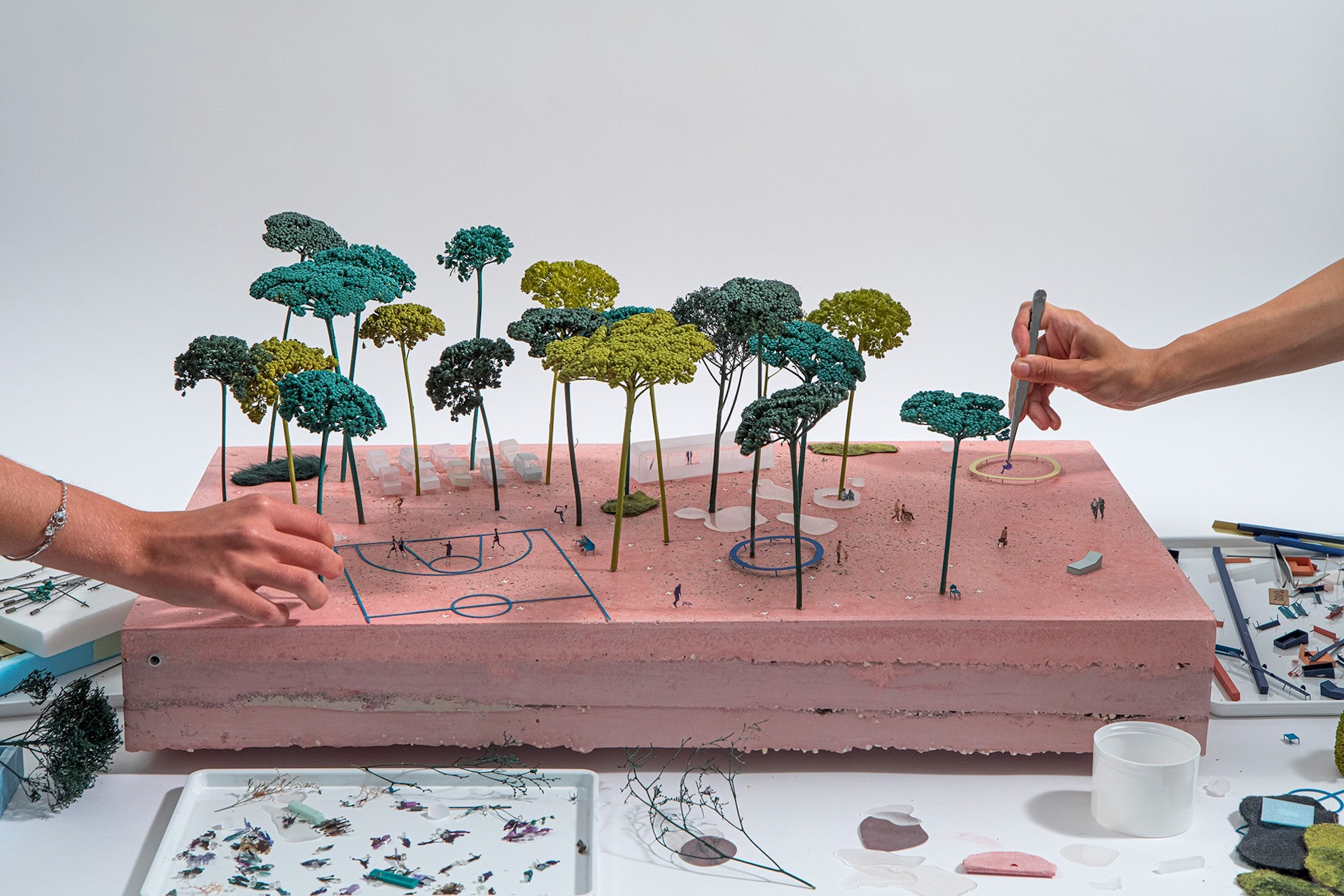
Place la Cruz, created by Enlace Arquitectura de la main with FUDEP in La Palomera, a barrio of Caracas, in 2017 – © Marcos Colina López
Marcos Colina López, doctoral student in architecture, urban planning and the environment at CNAM and ENSA Paris-la Villette, will present his thesis entitled “Fabriquer et transformer des ‘espaces publics’ dans les barrios de Caracas. Conflits et hybridations entre savoirs de l’architecture et de l’autoproduction”.
The thesis was prepared within the laboratoire espaces transformations (LET), under the supervision of Jodelle Zetlaoui-Léger (ENSAPLV) and co-supervised by Bendicht Weber (ENSAPLV) and Florinda Amaya (Universidad central de Venezuela).
Summary
This thesis investigates the nature and modalities of action of architects in self-built neighborhoods(barrios) in Caracas. This form of urbanization, in which residents take charge of almost all housing and infrastructure construction, is dominant in Venezuela as in many other Latin American countries. Since 1960, external actors, including Venezuelan and foreign architects, have contributed to varying degrees to the transformation of these barrios, in particular to reduce their vulnerability to a number of urban risks. While, from the 1960s onwards, these architects worked with the public authorities, over the last twenty years or so in Caracas, many of them have become autonomous in their actions, exploring a new project situation. They assert the need for a different form of collaboration with local residents, and are committed to transforming places and objects for collective use, calling them “public space”. Why do they favor this type of space in their interventions? What do they hope to achieve with these actions? How do they position themselves and work with these residents? What is the nature and scope of these collaborations?
The thesis is organized into four parts. The first sets out a double critical genealogy: on the one hand, on the intervention of architects in Venezuelan barrios, and on the other, on the constitution of a new category of professional action for architects, in favor of this type of territory. The second, based on case studies, analyzes the “testing” of architects’ work and “public space” in the self-built city. The third analyzes the controversies raised by these collaborations in terms of knowledge, socio-spatial representations and project strategies. Finally, the fourth part examines how city-dwellers and architects overcome controversies and evolve their repertoires of thought and action, and even their knowledge systems and values. Ultimately, the thesis examines and interprets the mechanisms of individual and collective learning in the constrained frugality of Caracas’ barrios.
Jury composition
Anne Coste, Professor HDR, ENSA Grenoble-UGA, AE&CC (reporter)
Jérôme Monnet, Professor HDR, Université Gustave Eiffel, LVMT (rapporteur)
Héloïse Nez, HDR Professor, Université Paris Cité, LIED (reviewer)
Nicolas Tixier, Professor HDR, ENSA Grenoble-UGA, AAU (examiner)
Julien Rebotier, HDR research fellow, CNRS, TREE (reviewer)
Yaneira Wilson, Senior Lecturer, ENSA Paris-Val de Seine, LAVUE-CRH (guest)
Jodelle Zetlaoui-Léger, HDR Professor, ENSA Paris-la Villette, LAVUE-LET (thesis supervisor)
Bendicht Weber, former ENSA professor, LAVUE-LET (thesis co-director)
Florinda Amaya, Professor, Central University of Venezuela (thesis co-director)