Marges de manœuvres #03: Faire, Defaire, Remaire: Interrogating the Reversal
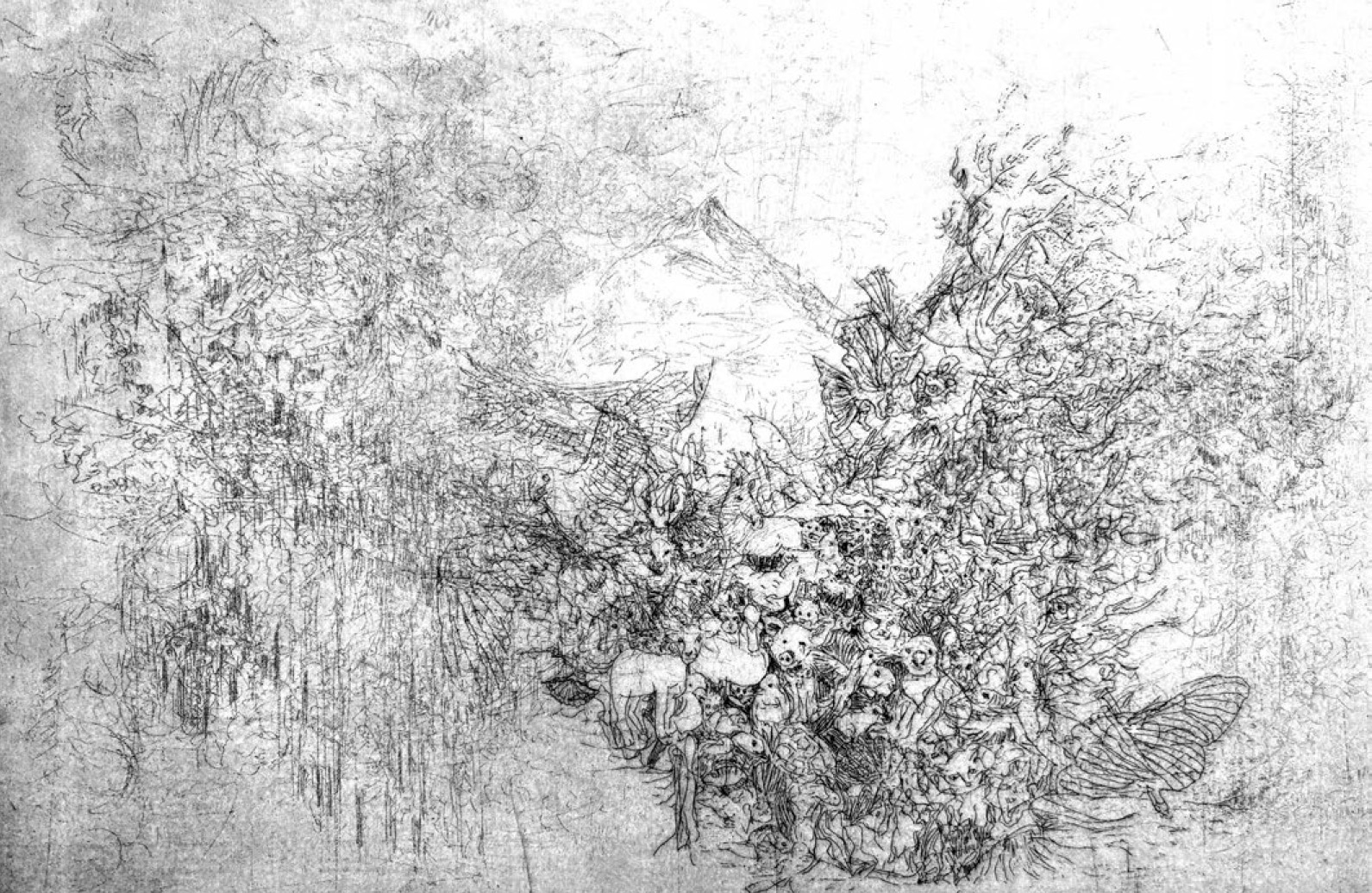
© Etching on copper, 2024 - © Élodie Mas
Since 2023, the arts and techniques of representation (ATR) of the ENSAs have organized a number of study days on a national scale:
- Marges de manœuvre #01, “Ce que peut l’enseignement des Arts et Techniques de la Représentation en temps de crise” (ENSA Clermont-Ferrand and ENSA Paris-Est);
- Marges de manœuvre #02, “L’art comme puissance de faire dans les écoles d’architecture et du paysage” (ENSA Marseille and ENSA Montpellier).
At a time when thinking is being called into question, these creative encounters are invaluable. They enable us to move from the experience of teaching to a reflective practice, and also to take a critical look at our training programs at a time when they are being transformed. In fact, these exchanges are attracting the interest of teacher-researchers beyond the Art and Technique of Representation (ATR) domain of architecture schools.
As such, the symposium is open to all those who wish to approach practice as a means of knowledge.
The third edition of the colloquium, on the theme “Faire, Defaire, Refaire : Interroger le Renversement”, was initiated by Chantal Dugave, artist-architect, professor in ATR at ENSA Paris-la Villette, laboratory GERPHAU EA 7486, and Gabriele Pierluisi, architect, professor HDR in ATR at ENSA Versailles, laboratory LéaV.
This symposium is an extension of the previous two, examining the pedagogy, practices and research dynamics involved. The ATR discipline offers a wide range of training courses, from architectural representation (analog and digital) to the plastic arts. The aim is to understand how these creative and design practices displace the notion of quality, shifting it from the realm of aesthetics to that of hybridization and the integration of complexity.
Hybridization is a key concept. It makes it possible to understand the multiple levels of reflection we need to elicit in students. Practices are already hybrid. They are articulated between the observation of the existing, the imagination of a future and the artistic approaches to be mobilized to question the architectural dimension. Similarly, from a research point of view, the protocol is also hybrid in that it introduces tools and approaches belonging to different epistemologies or methodologies.
While the two previous Marges de manœuvre meetings have focused on the creative process of making, this symposium will also analyze the notions of undoing and redoing. The aim is to reflect on the reasons why undoing is necessary, prior to the phase of re-doing. We’ll also see that, thanks to research, it will be possible to establish a critical distance from productive action. With creative processes no longer associated solely with making, but also with making-unmaking-remaking, we will have the opportunity to study this reversal through exchanges over the two days.
Two days, two venues
Thursday, February 19
ENSA Versailles – 5 avenue de Sceaux, 78000 Versailles, France
Friday, February 20
ENSA Paris-la Villette – 144 avenue de Flandre, 75019 Paris
Scientific Committee
- Chantal Dugave, artist-architect, ATR professor at ENSA Paris-la Villette, GERPHAU laboratory
- Anne-Valérie Gasc, artist, HDR professor in ATR at ENSA Marseille, Project[s] laboratory
- Grazia Giacco, musician, HDR professor of music and musicology at the University of Strasbourg, UR 3402 ACCRA – Contemporary approaches to artistic creation and reflection
- Sonia Keravel, landscape architect, HDR lecturer at the École nationale supérieure de paysage, LAREP laboratory – Project department
- Élodie Mas, engraver-architect, lecturer at ENSA Lyon
- Alessandro Mosca, architect, lecturer in TPCAU at ENSA Paris-Val de Seine, painter
- François Pernot, Professor of Modern History at the University of Cergy, “Scientific Director of the University Research School (EUR) “Humanities, Creation, Heritage”.
- Gabriele Pierluisi, architect, ATR HDR professor at ENSA Versailles, LéaV laboratory
- Éric Watier, artist, ATR professor at ENSA Montpellier, LIFAM laboratory