Call for papers - Towards new alliances: ecological struggles and territorial projects in contemporary rural areas
Le Vent se lève! /
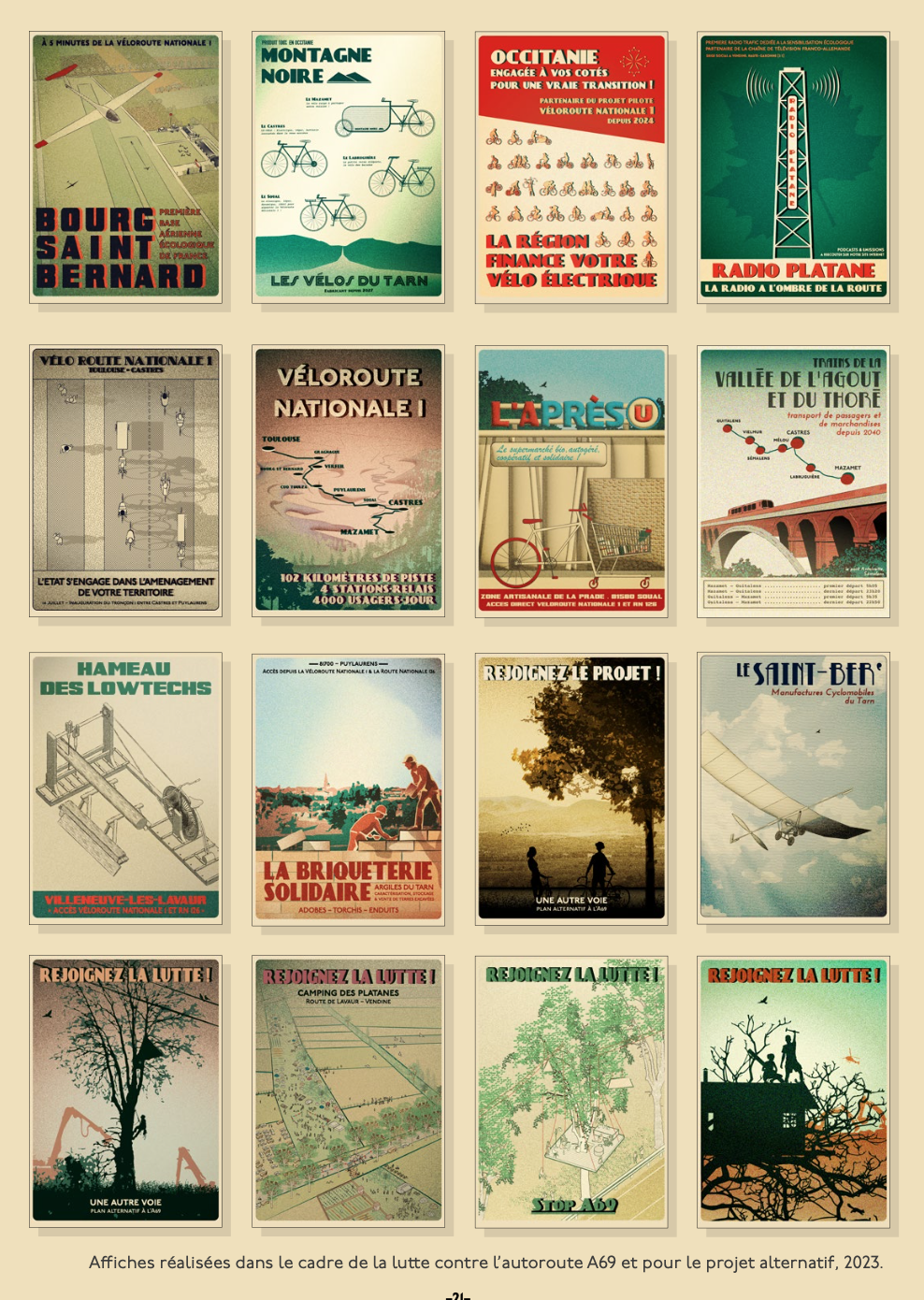
Posters produced as part of the fight against the A69 freeway and for the alternative project
– © Karim Lahiani, 2023
The Rencontres 2026 du réseau pédagogique et scientifique en architecture “Perspectives rurales” will be held from April 27 to 29, 2026 in the Haut-Rhin region of France.
Deadline for paper proposals: January 6, 2026 at midnight
Submission details:
The PERS network meetings are designed to appeal to a wide range of audiences: researchers from different disciplines, as well as local and civil society players. They will be organized in sequences. This call for papers is open to individuals as well as institutions, associations and collectives sharing the same concerns.
Three types of submissions are possible: sequences, papers and posters.
Meeting themes
The next meetings of the Perspectives Rurales scientific and educational network – which brings together teacher-researchers from higher education establishments in architecture, agronomy, landscape and urban planning in France and Europe, as well as the Parcs Naturels Régionaux federation – aim to examine the ways in which the practices of space/planning professionals are being redefined in the light of the resistances and struggles that are traversing and recomposing contemporary ruralities, through the following five axes:
- Projecting alternatives: projects and counter-projects. Preventing or forking out? Doing things despite everything, but doing them differently? The practices, knowledge and methods of design, investigation, representation and training of space professionals are mobilized and reinterrogated in contexts of struggle, local mobilization or resistance. What role do these approaches play, or have played in the past, in collective mobilizations? In what ways do alternative or counter-projects also help to reconcile and recompose different conflicting interests, and contribute to the creation of collective narratives? Or to assert or even radicalize positions?
- Experimenting in the field: taking action, building and transforming through mobilization. Fighting as a laboratory? Many mobilizations are based on more or less permanent occupations. What spatial forms do these occupations take? How do they make broader demands visible? What visions of alternative futures emerge from these occupations, and in what ways? How does resistance fit into a time frame? What thoughts about spatial projects emerge from or run through these occupations?
- Subsisting on the margins: alternative ways of living in a place. Discreet resistance? Numerous forms of resistance can only emerge and be sustained if they remain marginal, without attacking head-on the very logics they contradict. How do these experiences challenge the dominant ecological discourse? Today, as in the past, are rural areas more receptive to these alternatives than metropolises? Can they go beyond the aspirations of a small group of individuals and form the basis of a territorial project?
- Connecting: to places, to others in the struggle. What local and global alliances? Struggles are often based on the consolidation of a collective committed to constructed and negotiated positions. How does highlighting territorial and spatial issues help to broaden mobilizations and bring together residents and players from different backgrounds? How do they relate, today as in the past, to other local or global struggles (feminist, anti-racist, anti-capitalist, decolonial movements, etc.)?
- Learning and teaching from struggles: what transfers of knowledge and learning between militant and academic spheres? Struggles, whether discrete or visible, mobilize and produce knowledge, which is shared and exchanged from militant spheres. How is this knowledge transferred to space professionals? What prospects do they open up for the development of training courses? What forms of research are involved?
News
Call for papers - Languages, things, practices: architecture as an in-discipline
A call for papers has been launched for Research Day, an initiative of ENSA Paris-la Villette doctoral students, to be held on Thursday, May 28, 2026 at the school – site des Ardennes.
This day proposes to open the debate: “How can we think of architecture as an in-discipline, not to free ourselves from all rigor, but to experiment with our other ways of doing science?”
Call for papers - Literary spaces. Architecture and literature
A call for papers has been launched for two study days to be held on Wednesday May 20 and Thursday May 21, 2026 at ENSA Paris-la Villette – site des Ardennes.
These study days will focus on spaces as a point of decompartmentalization between the literary and architectural domains, and aim to bring together the ideas and knowledge of researchers and teachers, as well as professionals, artisans of space and language.
Three thematic orientations (not exhaustive) are proposed to future contributors:
- Inhabiting, narrating, “designing” space-time
- Reinventing space, thinking literature: literary theories and habitable heterotopias
- Landscape poetics

Are you about to graduate from a course in architecture and thinking of taking up a thesis?
Give yourself the opportunity to spend an extra year in a Post-Master’s program to consolidate your choice and acculturate you to the world of architectural research with a first experience in a laboratory!
Discover 10 good reasons to enroll in ENSAPLV’s Research in Architecture post-master program!
The first online application session for the 2025-2026 academic year will open from June 2 to June 30, 2025.