ENSA Paris-la Villette, member of the TAP consortium - Transitions Architecture Paysage
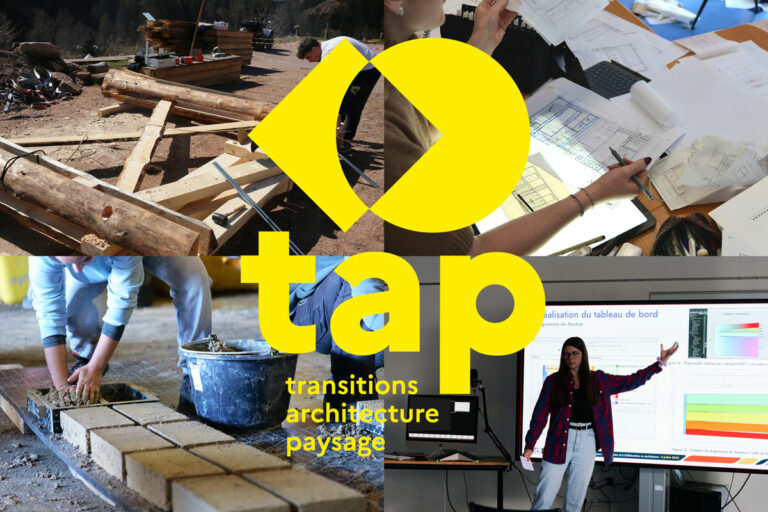
The TAP project, winner of the AMI “Compétences et métiers d’avenir “* competition, aims to transform training courses in architecture and landscape over the period 2025-2030 to meet the challenges of digital and ecological transitions.
It is supported by the ENSA-P network and its partners: REFC’A (Réseau pour la formation continue des architectes), amàco (association developing training, research and experimentation activities in eco-construction), INSA Val de Loire, INSA Strasbourg, CNOA and École de Chaillot (heritage architects).
The reason for the TAP project
The TAP project is based on the premise that designers are a key lever for transforming the building industry and planning processes. It affirms the key role of designers in decarbonization. The aim is to respond to the need for changes in training and professions in the architecture and landscape sectors (new challenges and professions to train architects in, shortage of designers and landscape architects). To carry out this five-year project within the framework of the objectives and levers of France 2030, a consortium bringing together all the design sectors is committed to deploying expertise in the network of partner establishments, developing the skills required for the evolution of training courses, and pooling pedagogical engineering for the benefit of training courses.
5-year objectives :
- Adapting ENSA-P teaching models (initial and sandwich courses)
Working group led by ENSA Nancy and ENSA Normandie + 12 consortium members - Develop training for trainers (and pedagogical tools)
Working group led by amàco + 6 consortium members - Amplify and federate a continuing education offering in the form of territorial campuses involving local players (creation of modules, links with research and entrepreneurship)
Working group led by REFC’A + 7 consortium members
Overall management: ENSA Normandie, lead partner + 11 consortium members
The total budget for this project is 5 million euros over 5 years.
Contributions from ENSA Paris-la Villette
On October 8 and 9, 2026, the school, via the RAMAU network (Réseau activités et métiers de l’architecture et de l’urbanisme), will organize a two-day thematic meeting, as part of the nine-day cycle that will mark the first year of the TAP project.
Entitled “Taking care of the living environment. Urban professions in transition? this meeting is divided into two parts:
- Thursday, October 8: “Evolutions in architectural practices and cross-fertilization with urban planning and landscape”
The day will be addressed to the group of ENSA teachers taking part in the cycle. Based on the results of the CMA-Archi study (Compétences et métiers d’avenir de la filière Architecture, France 2030), it will explore the diversity of architectural professions, and discuss how this diversity in the careers of architecture graduates raises questions about teaching methods at ENSAs. Several sequences are envisaged: presentation of the dynamics of diversification of practices and evocation of the profiles identified in the diagnostic phase; testimonials from practitioners; cross-examination of the evolution of professional practices in urban planning and landscape; focus groups on the pedagogical implications of diversification. - Friday, October 9: “Diversification and change in urban professions. Insights from three research fields in Belgium, Switzerland and France”
The day will be a RAMAU day open to TAP participants. It will discuss and cross-reference three research projects currently underway within the network, which have in common the need to analyze the effects of major societal transition dynamics on professional activities in the field of city making and management: the ANR ProMétUrba21 “Architectes, urbanistes et paysagistes face aux défis du 21e siècle” (V. Biau, E. Macaire, B. Horsch et al.); “Les invisibilisés-es de la nature urbaine en transition : représentations, pratiques et savoirs populaires”, research funded by the FRS-FNRS (C. Schaut et al. ULB Bruxelles); “Participez! Les faiseurs de quartier, entre urbanisme et action sociale”, research funded by the SNSF (L. Matthey et al. University of Geneva).
Over the five years of the project, RAMAU, of which LET-ENSAPLV is the network leader, is committed to contributing to the formulation of the TAP training offer.
Agenda general
Launch event: Wednesday July 8 at ENSA Normandie
The aim of this event, which will bring together all those involved in the TAP project, is to present the progress and objectives of Year 1, and to raise awareness of the project among those involved in the architecture and landscape training courses.
Program and registration to follow.
*What is AMI-CMA?
The “Skills and professions of the future” call for expressions of interest (AMI-CMA) is part of France 2030, and aims to prepare the skills required to meet the needs of tomorrow’s strategic and emerging sectors.
The AMI is supported by the Secrétariat Général pour l’Investissement (SGPI) and managed on behalf of the French government by the Agence Nationale de la Recherche (ANR) and the Caisse des Dépôts et des Consignations (CDC). The Ministry of Labor and Employment is one of the lead ministries, alongside the Ministries of National Education and Higher Education and Research. The Ministries of the Economy, Agriculture and the Environment are also involved.


News
Financial manager in the finance department (M/F)
Application deadline: 08/23/2026
Position open to permanent and contract employees
Contract type: T2
Statutory category: B
Job category: SEADM – Administrative Secretary

Start of the 2026–2027 Academic Year
Are you a freshman or an upperclassman, an incoming international exchange student, or a new faculty member…?
Find the key dates for the 2026–2027 academic year here!
Research Program Support and Promotion Specialist (M/F)
Application deadline: August 6, 2026
Position open to permanent and contract employees
Contract type: T2
Statutory category: A (RIFSEEP Group 3 / Job Group 3 under the Albanel Circular)
Professional category: Design Engineers
ENSAPLV summer closure!
The school will be closed from July 25 through August 23, 2026, inclusive.
The administrative staff will return to work on Monday, August 24, 2026.ENSAPLV wishes you a wonderful summer!

Enseignant contractuel T3 / TPCAU - 70h (H/F)
Application deadline: July 10, 2026
T3 Tenure-Track Position
Statutory Category: A
Discipline Group: Theories and Practices of Architectural and Urban Design (TPCAU)ENSA Paris-la Villette and the CFA of the Conservatoire national des arts et métiers (CNAM) are offering a new bachelor’s-level apprenticeship program starting in the 2026–2027 academic year: the CARE Bachelor’s Degree—Coordinating and Supporting Energy-Efficiency Renovations. The instructor (M/F) sought will be responsible for a project workshop (70 hours) in Semester 1.

Key Economic Indicators for the Architecture Industry
The Architecture Economy Observatory, a collaborative body launched in 2021 by the Ministry of Culture that brings together stakeholders in the profession, has published the “Key Figures on the Architecture Economy” for the first time.
The observatory’s work is part of the National Strategy for Architecture 2025–2029, one of whose measures aims to expand knowledge of the architectural economy in all its dimensions.